Choosing the right QHSE course can feel overwhelming when you're faced with multiple standards (ISO 9001, ISO 14001, ISO 45001) and different auditor pathways (Internal Auditor, Lead Auditor, Lead Implementer). deGRANDSON Global makes this decision easier by offering structured, self-paced courses that map directly to your career goals and compliance requirements.
This guide walks you through everything you need to know about selecting the right QHSE training pathway. You'll learn what QHSE actually means, how each course type differs, and how to match your professional role to the right certification sequence. By the end, you'll have a clear roadmap for your ISO auditor training journey.
Key Takeaways: Choose QHSE Courses for ISO 9001, 14001, 45001
- QHSE stands for Quality, Health, Safety, and Environment—covering ISO 9001, ISO 45001, and ISO 14001 management systems respectively.
- Internal Auditor courses prepare you to conduct first-party audits, while Lead Auditor courses qualify you for second and third-party certification audits.
- Lead Implementer training focuses on building and maintaining management systems rather than auditing them, making it ideal for system managers.
- deGRANDSON Global delivers ISO 21001-certified QHSE courses with 24/7 tutor support, letting you study on your own schedule from anywhere.
- Your ideal QHSE course path depends on whether you want to audit systems, implement them, or consult on ISO certification projects.
What Does QHSE Stand For and Why Does It Matter?
QHSE represents four interconnected management disciplines: Quality, Health, Safety, and Environment. Each discipline has its own ISO standard. ISO 9001 covers quality management. ISO 45001 addresses occupational health and safety, while ISO 14001 addresses environmental management.
Organizations often implement these standards together because they share a common structure (the Annex SL framework). This means a single integrated management system can address quality, worker safety, and environmental performance simultaneously. For you as a professional, QHSE training opens doors across all three disciplines.
The Relationship Between QHSE and Integrated Management Systems
An Integrated Management System (IMS) combines two or more management systems into one cohesive framework. Many organizations merge their ISO 9001, ISO 14001, and ISO 45001 systems to reduce duplication, cut audit costs, and streamline documentation.
If you work in a company with an IMS, you'll benefit from training that covers multiple standards. Some professionals start with one standard and add competencies in others over time. Others pursue integrated auditor qualifications from the outset.
What Are the Three Main QHSE Course Types?
Three primary certification pathways exist for QHSE professionals: Internal Auditor, Lead Auditor, and Lead Implementer. Each serves a distinct purpose in the ISO management system lifecycle. Your career objectives determine which path fits you.
Internal Auditor Courses for QHSE Standards
Internal Auditor training prepares you to conduct first-party audits on behalf of your own organization. You'll learn to assess whether your company's management system conforms to ISO requirements and whether processes work as intended.
This is typically the entry point for QHSE professionals. Internal auditor courses cover the relevant standards' requirements, audit principles based on ISO 19011, and techniques for gathering objective evidence. Course duration is usually shorter than lead auditor programs, often around 16-20 hours of study time.
Lead Auditor Courses for ISO 9001, ISO 14001, and ISO 45001
Lead Auditor certification enables you to plan, lead, and report on second-party (supplier) and third-party (certification body) audits. This qualification is essential if you want to work as an external auditor for a certification body or conduct supplier assessments for your organization.
Lead Auditor courses are more extensive than internal auditor programs. They cover audit program management, team leadership, audit planning and execution, nonconformity writing, and closing meetings. Expect around 40 hours of study time for a full lead auditor course. You'll also need prior knowledge of the standard and some audit experience to get the most from this training.
Lead Implementer Courses for Building Management Systems
Lead Implementer training teaches you how to establish, implement, and maintain an ISO management system from scratch. This pathway suits you if your role involves system design rather than auditing.
QHSE managers, quality managers, and consultants who help organizations achieve certification often take this route. The curriculum covers gap analysis, documentation development, risk assessment methodologies, and preparing for certification audits. deGRANDSON Global offers Lead Implementer courses for ISO 9001, ISO 14001, and ISO 45001.

How to Match Your Job Role to the Right QHSE Course Path
Your current position and career aspirations should drive your course selection. Different roles demand different competencies. Here's how to align your training with your professional goals.
QHSE Manager and Quality Manager Course Recommendations
If you manage your organization's QHSE function, you need broad competence across auditing and implementation. Start with the Internal Auditor certification in your primary standard (often ISO 9001 for quality managers or ISO 45001 for HSE managers). Add Lead Implementer training if you're responsible for building or maintaining the management system.
Many QHSE managers then progress to Lead Auditor certification to deepen their audit skills and enhance their professional credibility. This combination lets you both maintain your organization's system and conduct rigorous internal audits.
QHSE Consultant Course Recommendations
Consultants helping multiple organizations achieve ISO certification need the full toolkit. Lead Implementer training equips you to guide clients through the system development process. Lead Auditor certification adds credibility and enables you to prepare clients for their certification audits.
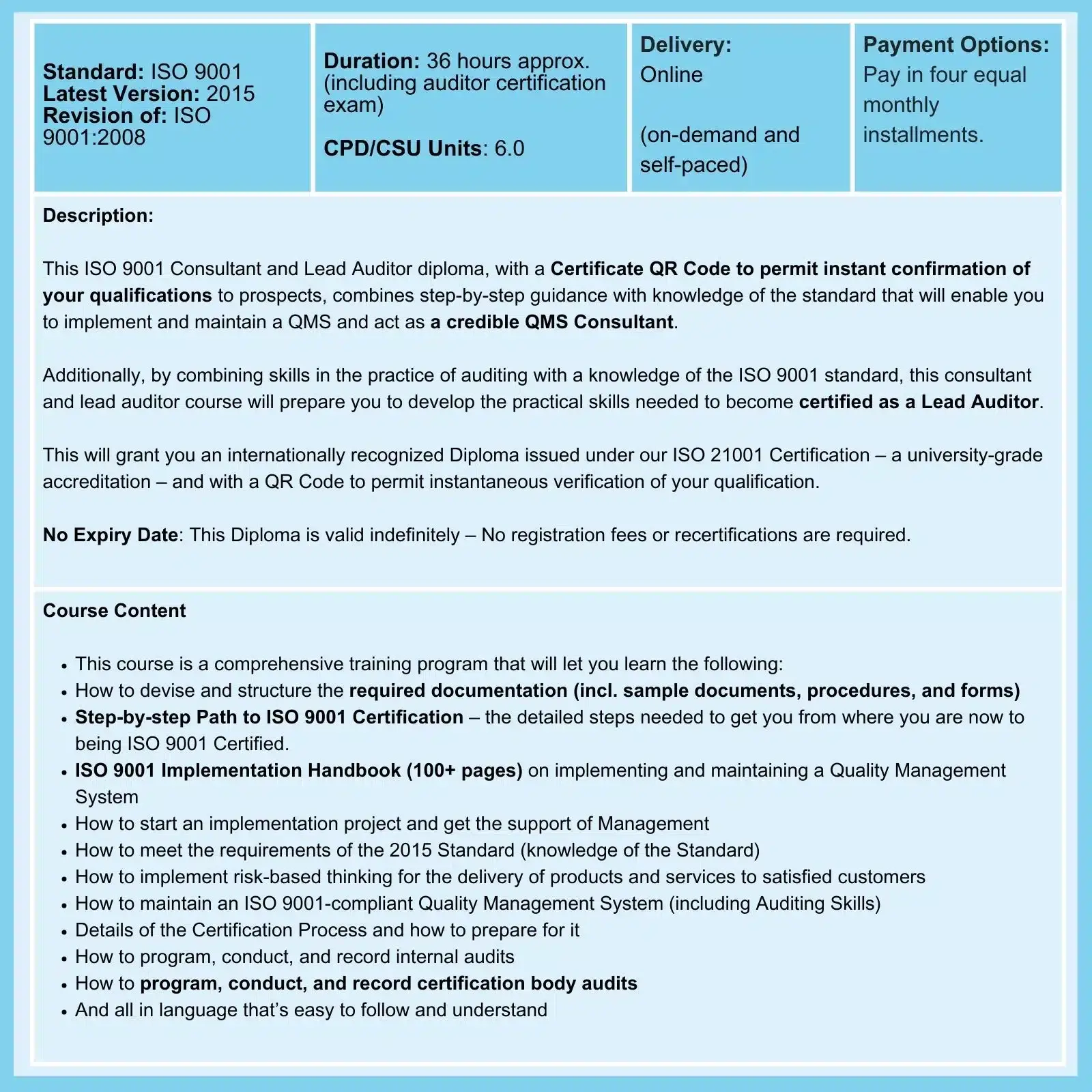
deGRANDSON Global offers a QHSE Consultant Professional Diploma that combines training across ISO 9001, ISO 14001, and ISO 45001. This pathway gives you integrated competence across all three core QHSE standards in a single program.
Certification Body Auditor Course Requirements
If you want to work for an accredited certification body conducting third-party audits, Lead Auditor certification is mandatory. Certification bodies require evidence of completed lead auditor training plus documented audit experience before admitting auditors to their registers.
Most certification bodies also expect auditors to maintain their competence through regular refresher training. Lead Auditor Refresher courses help you stay current with standard revisions and audit best practices without repeating the full course.
Understanding ISO 9001 Course Options for Quality Professionals
ISO 9001 is the most widely adopted management system standard globally. It establishes requirements for a quality management system (QMS) focused on customer satisfaction and process improvement. Quality professionals at all levels benefit from ISO 9001 training.
ISO 9001 Internal Auditor Certification Path
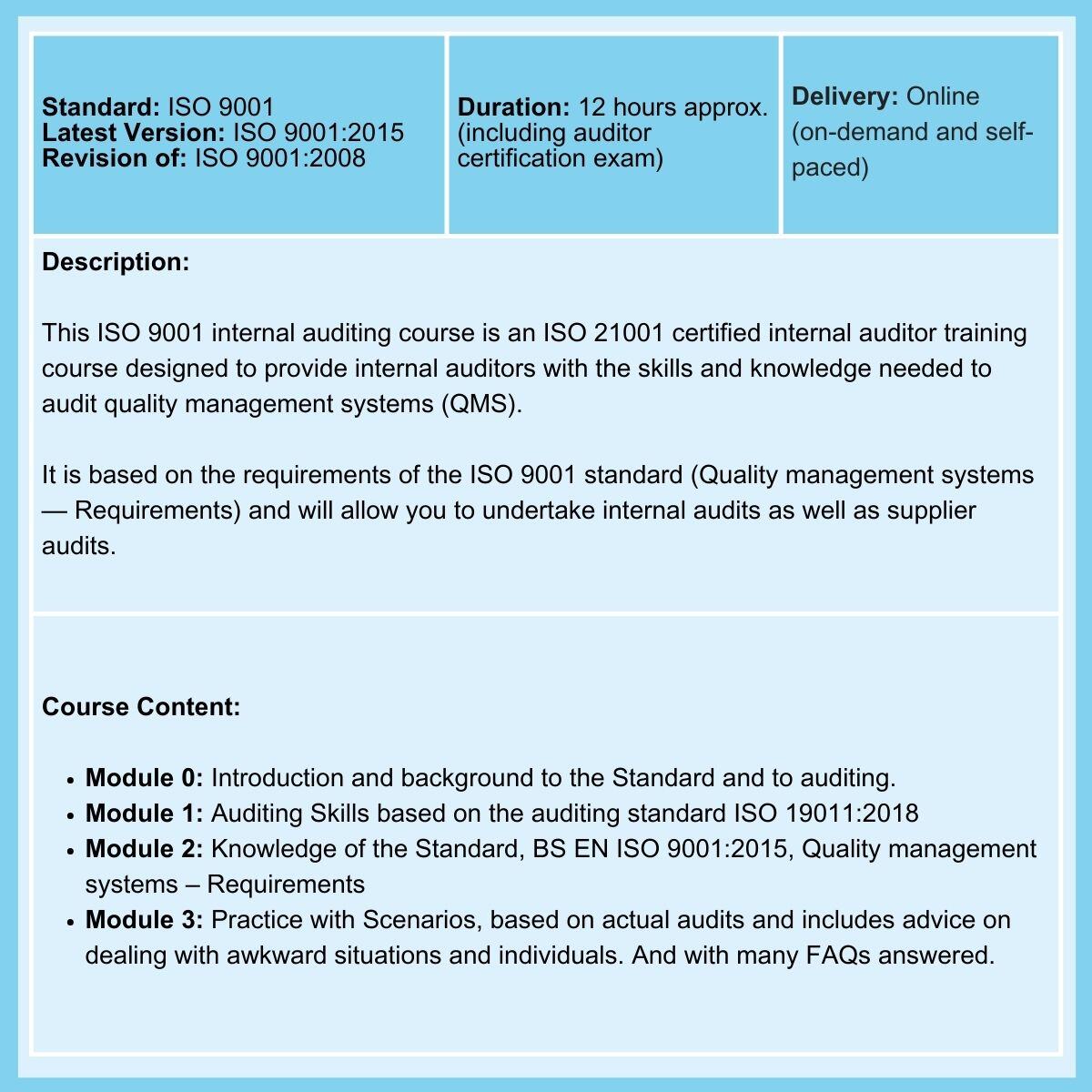
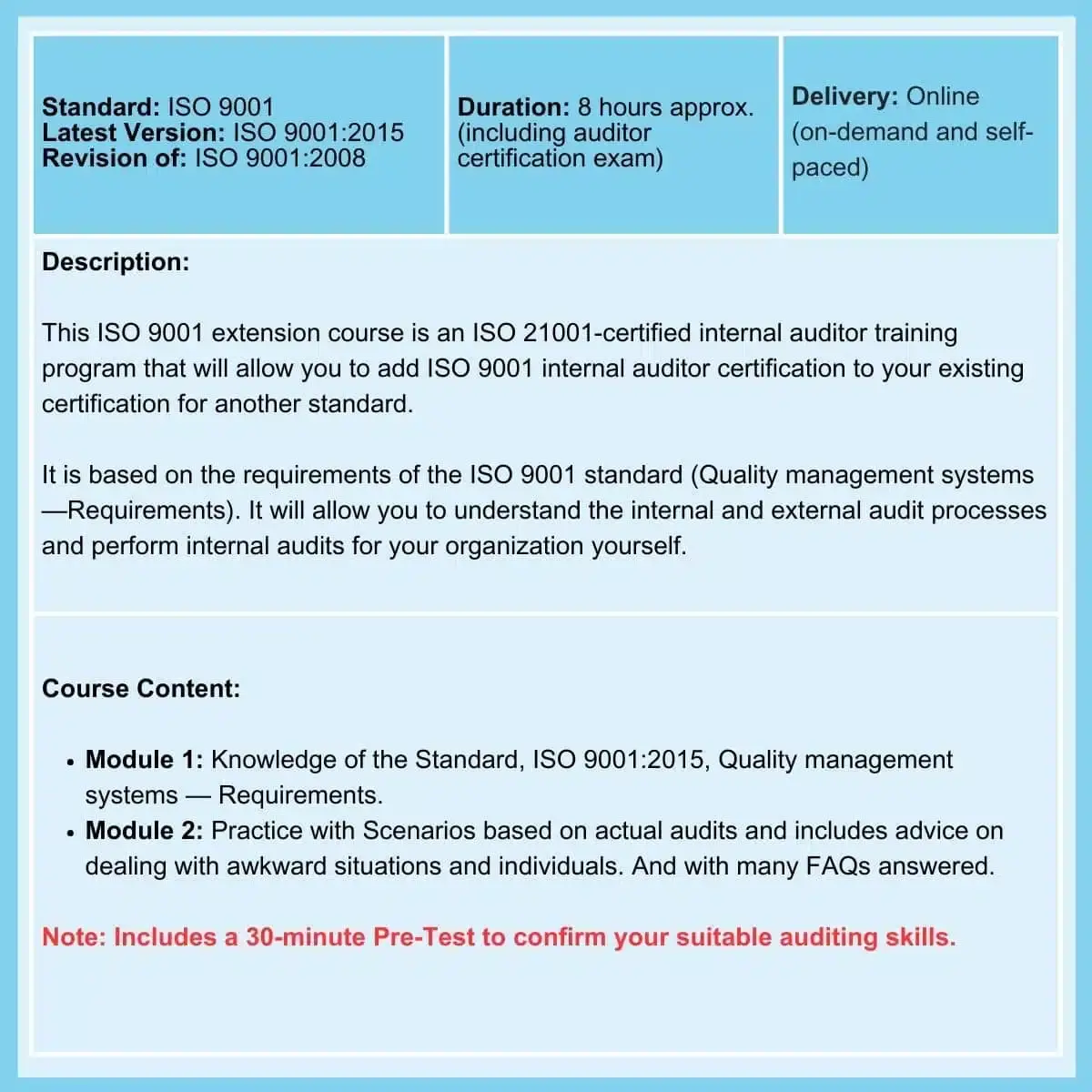
The ISO 9001 Internal Auditor course teaches you to audit quality management systems against the standard's requirements. You'll learn clause-by-clause interpretation, audit planning techniques, and how to write meaningful audit findings.
This certification is suitable for quality engineers, quality coordinators, and anyone involved in maintaining the QMS. deGRANDSON Global's ISO 9001 Internal Auditor course covers the full standard and includes practical exercises to build your auditing confidence.
ISO 9001 Lead Auditor Certification Path
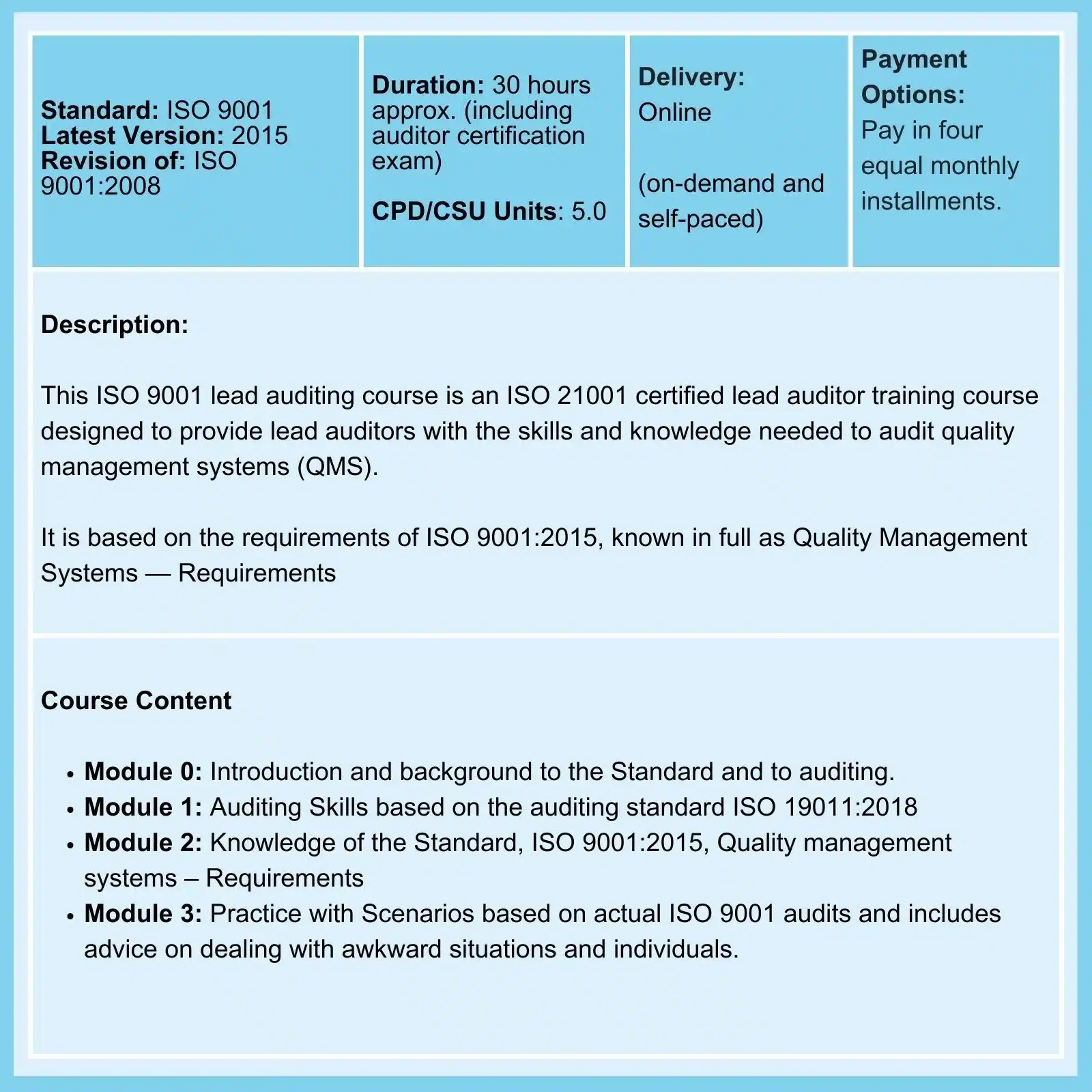
ISO 9001 Lead Auditor training builds on internal auditor knowledge, equipping you with advanced skills to manage audit teams and conduct certification audits. You'll master techniques for opening and closing meetings, coordinating the auditor team, and making certification recommendations.
This qualification is valuable for senior quality professionals, supplier quality engineers who assess vendor systems, and anyone pursuing a career in third-party auditing. The course typically requires prior knowledge of QMS.
ISO 9001 Lead Implementer Certification Path
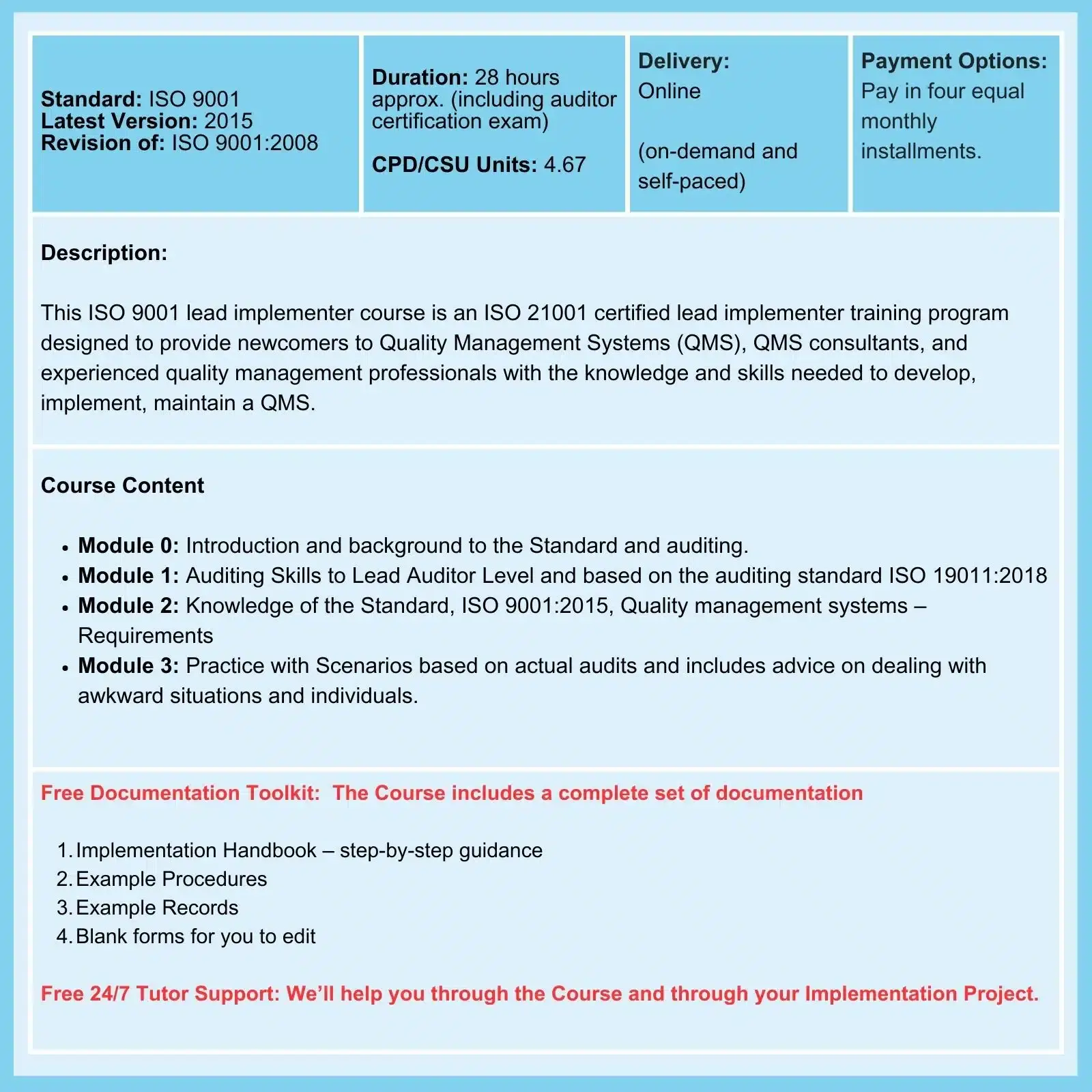
If your role involves building a QMS rather than auditing one, the ISO 9001 Lead Implementer course is your starting point. You'll learn to conduct gap analyses, develop quality policies and objectives, create documented information, and prepare your organization for certification.
Management representatives, quality directors, and consultants often take this route. The training covers practical implementation steps from initial planning through successful certification.

Understanding ISO 14001 Course Options for Environmental Professionals
ISO 14001 specifies requirements for an environmental management system (EMS). It helps organizations identify, control, and reduce their environmental impact. Environmental managers, sustainability professionals, and QHSE generalists all benefit from ISO 14001 training.
ISO 14001 Internal Auditor Certification Path
The ISO 14001 Internal Auditor course prepares you to audit your organization's environmental management system. You'll learn to assess environmental aspects, evaluate legal compliance processes, and verify operational controls.
This training is appropriate if you conduct internal EMS audits in your role. The course covers the standard's requirements, environmental terminology, and audit techniques specific to environmental management.
ISO 14001 Lead Auditor Certification Path
ISO 14001 Lead Auditor certification qualifies you to lead environmental management system audits for certification bodies or as part of supplier assessment programs. The course builds advanced competencies in audit leadership and environmental audit methodology.
Environmental consultants, HSE managers expanding their credentials, and professionals transitioning to roles with certification bodies often pursue this pathway.
ISO 14001 Lead Implementer Certification Path
The ISO 14001 Lead Implementer course teaches you to design and implement an environmental management system. You'll learn to identify significant environmental aspects, establish objectives and targets, and build operational controls that reduce environmental impact.
Environmental managers tasked with achieving ISO 14001 certification and consultants guiding clients through EMS implementation will find this training directly applicable.

Understanding ISO 45001 Course Options for Health and Safety Professionals
ISO 45001 establishes requirements for an occupational health and safety management system (OH&S MS). It replaced OHSAS 18001 and provides a framework for preventing work-related injuries and illnesses. HSE professionals and QHSE managers need competence in this standard.
ISO 45001 Internal Auditor Certification Path
The ISO 45001 Internal Auditor course prepares you to audit occupational health and safety management systems. You'll learn to assess hazard identification processes, evaluate risk controls, and verify worker consultation and participation mechanisms.
Safety officers, HSE coordinators, and anyone conducting internal OH&S audits should pursue this certification. The course covers the standard's unique requirements, including worker consultation and hierarchy of controls.
ISO 45001 Lead Auditor Certification Path
ISO 45001 Lead Auditor certification qualifies you to lead OH&S management system audits. This is essential for professionals wanting to conduct certification audits or comprehensive supplier safety assessments.
The course covers advanced audit techniques specific to health and safety, including assessing emergency preparedness, incident investigation processes, and safety performance monitoring.
ISO 45001 Lead Implementer Certification Path
The ISO 45001 Lead Implementer course teaches you to build and maintain an occupational health and safety management system. You'll learn to establish OH&S policies, conduct risk assessments using the hierarchy of controls, and implement operational procedures that protect workers.
Safety managers implementing new systems and consultants helping organizations transition from OHSAS 18001 benefit from this comprehensive training.

How to Build a Complete QHSE Training Program
Most QHSE professionals don't need just one course—they need a planned training sequence that builds competence over time. Here's how to structure your learning journey based on your starting point and goals.
Entry-Level QHSE Training Sequence
If you're new to QHSE, start with Internal Auditor training in your primary standard. Quality professionals typically begin with ISO 9001. HSE professionals often start with ISO 45001. Environmental specialists usually start with ISO 14001.
Once you've completed one Internal Auditor course and gained some practical experience, add the other relevant standards. Many professionals then pursue Internal Auditor Extension courses that add a second or third standard to their credentials without repeating the core auditing modules.
Mid-Career QHSE Training Sequence
Experienced professionals with internal auditor credentials should consider Lead Auditor or Lead Implementer training based on their career direction. If auditing is your focus, progress to the Lead Auditor role. If system building is your focus, choose Lead Implementer.
Adding a second or third standard at the Lead Auditor level creates powerful versatility. An integrated IMS Lead Auditor qualification demonstrates competence across ISO 9001, ISO 14001, and ISO 45001 simultaneously.
Advanced QHSE Training for Consultants and Senior Managers
Senior QHSE professionals and consultants benefit from diploma-level programs that combine multiple qualifications. deGRANDSON Global offers consultant diplomas that bundle Lead Implementer and Lead Auditor training with practical consulting skills.
These programs prepare you to guide organizations through their entire ISO journey, from initial planning through certification and ongoing improvement.

What Are the Prerequisites for QHSE Auditor Courses?
Prerequisites vary by course type. Understanding these requirements helps you choose courses you're ready to tackle.
Internal Auditor Course Prerequisites
Internal Auditor courses typically have minimal prerequisites. Basic knowledge of management systems is helpful but not mandatory—the course itself teaches the standard's requirements. No prior audit experience is required.
You should have reading comprehension skills to interpret standard clauses and a willingness to learn systematic assessment techniques. Anyone working in a QHSE-related role can successfully complete Internal Auditor training.
Lead Auditor Course Prerequisites
Lead Auditor courses expect you to arrive with foundational knowledge. You should understand the relevant requirements of the ISO standards before enrolling. Prior Internal Auditor training or equivalent experience provides the best preparation.
Most Lead Auditor programs also recommend some practical audit experience—even participating in a few internal audits as an observer or team member helps you connect theory with practice.
Lead Implementer Course Prerequisites
Lead Implementer courses benefit from some prior exposure to management systems, but no specific certifications are required. Understanding how organizations document and control processes gives you context for the implementation methods taught.
Professionals responsible for implementing or maintaining a management system get the most immediate value from this training.

Why ISO 21001 Accreditation Matters for QHSE Training
ISO 21001 is the international standard for educational organizations. When a training institution holds ISO 21001 certification, it means its course design, delivery, and learner support meet internationally recognized quality standards.
deGRANDSON Global operates as an ISO 21001-certified educational organization. This matters because your certificate carries credibility with employers and certification bodies. It also means you can expect structured learning materials, clear assessments, and responsive support throughout your studies.
When evaluating QHSE training options, check whether the training institution holds recognized accreditation. This protects your investment and ensures your qualification will be respected professionally.

What Study Format Works for QHSE Training?
QHSE courses come in various formats: classroom-based, live virtual, and self-paced online. Your learning preferences, schedule, and location should guide your choice.
Classroom-Based QHSE Training
Traditional classroom courses run over consecutive days (typically 2-5 days depending on the course level). They offer face-to-face interaction with instructors and other learners. This format suits people who learn better in structured environments with scheduled commitments.
The drawback is availability—you need to travel to a training location and block time in your calendar. Classroom courses are less flexible for working professionals.
Live Virtual QHSE Training
Live virtual courses deliver classroom-style instruction over video conferencing. You participate in real-time sessions with an instructor and other learners, but from your own location. This format removes travel requirements while maintaining a scheduled structure.
Live virtual training works well if you value instructor interaction but can't attend in person. However, you still need to block specific times for training sessions.
Self-Paced Online QHSE Training
Self-paced online courses let you study when it suits you. Materials are available 24/7, and you progress at your own speed. This format offers maximum flexibility for busy professionals.
deGRANDSON Global specializes in self-paced online delivery with 24/7 tutor support available when you need help. You can start immediately, pause when work demands attention, and resume when you're ready. This format works exceptionally well for QHSE professionals, balancing training with operational responsibilities.
How Long Does QHSE Auditor Certification Take?
Completion time depends on the course type and your study schedule. Here's what to expect for each pathway.
Internal Auditor Course Duration
Internal Auditor courses typically require 16-20 hours of study time. With self-paced learning, many professionals complete these courses in 2-4 weeks while working full-time. Dedicated study can compress this to 1-2 weeks.
The course includes the standard's requirements, auditing principles, and practical exercises. You'll take module assessments throughout and a final examination to demonstrate competence.
Lead Auditor Course Duration
Lead Auditor courses require more substantial study time—typically 40-50 hours. Working professionals often complete lead auditor training in 6-10 weeks with consistent part-time study. Those with more available time can finish in 4-6 weeks.
These courses cover audit program management, team leadership, detailed audit methodology, and reporting. Assessment includes module tests and comprehensive final examinations.
Lead Implementer Course Duration
Lead Implementer courses typically require 35-45 hours of study. Completion time mirrors lead auditor courses—roughly 6-10 weeks for working professionals studying part-time.
The curriculum covers implementation methodology from planning through certification, including documentation development and audit preparation.
What Happens After You Complete QHSE Training?
Completing a QHSE course is the beginning, not the end. Here's how to turn your new qualification into practical value.
Receiving Your Certificate
Upon successful course completion, you'll receive a certificate documenting your qualification. deGRANDSON Global certificates include QR code verification, allowing employers and certification bodies to instantly confirm your credentials.
This verification feature adds credibility when you present your qualifications to potential employers or clients.
Applying Your New Skills
Internal Auditor certification enables you to participate in or lead your organization's internal audit program. Lead Auditor certification qualifies you for second and third-party auditing roles. Lead Implementer certification prepares you to drive ISO certification projects.
The best way to cement new knowledge is to apply it promptly. Volunteer for the next internal audit, take ownership of a system improvement initiative, or use your new skills on a current project.
Maintaining and Expanding Your Qualifications
ISO standards evolve, and your competence should too. Refresher courses help you stay current with standard revisions and audit best practices. Extension courses let you add additional standards to existing qualifications efficiently.
Many professionals plan a multi-year learning journey, adding qualifications progressively as their careers develop.
In Conclusion: Choosing Your QHSE Course Path for ISO Success
Your ideal QHSE course depends on your current role, career goals, and the standards most relevant to your organization. Internal Auditor training offers the right starting point for most professionals. Lead Auditor certification suits those focused on audit careers. Lead Implementer training fits system builders and consultants.
Consider starting with one standard in your primary discipline, then expanding to cover additional standards as your career progresses. Self-paced online learning from an ISO 21001-certified institution like deGRANDSON Global gives you flexibility to balance training with work responsibilities while earning internationally recognized credentials.
Take time to map your learning journey against your career objectives. The right sequence of QHSE courses builds competence systematically and positions you for advancement in this growing field.
FAQs About QHSE Courses for ISO 9001, 14001, and 45001
What is the difference between the Internal Auditor and Lead Auditor certifications?
Internal Auditor certification prepares you to conduct first-party audits on your own organization's management system. Lead Auditor certification qualifies you to plan, lead, and report on second-party (supplier) and third-party (certification body) audits.
The lead auditor course is longer and covers audit team management, advanced methodology, and certification decision processes that internal auditor courses don't address.
Do I need an Internal Auditor certification before taking Lead Auditor training?
Internal Auditor certification isn't technically required, but foundational knowledge of the standard is expected. deGRANDSON Global recommends completing Internal Auditor training first or having equivalent work experience with the relevant ISO standard.
This preparation ensures you get maximum value from the more advanced Lead Auditor curriculum.
Can I audit multiple ISO standards with one qualification?
Yes—Integrated Management System (IMS) auditor courses qualify you to audit multiple standards. deGRANDSON Global offers IMS Internal Auditor and IMS Lead Auditor programs covering ISO 9001, ISO 14001, and ISO 45001 together.
Alternatively, you can earn separate qualifications in each standard and then audit them individually or in combination.
How long is a QHSE auditor certificate valid?
deGRANDSON Global certificates don't expire. However, professional best practice recommends refresher training every three years or when standards undergo significant revision.
Some employers and certification body registers have their own recertification requirements, so check any specific rules that apply to your situation.
What is ISO 21001 and why does it matter for training?
ISO 21001 is the international standard for educational organizations. deGRANDSON Global holds ISO 21001 certification, meaning our courses meet rigorous quality standards for curriculum design, delivery, and learner support.
Your certificate carries the ISO 21001 accreditation mark, giving it credibility with employers worldwide.
Can I study QHSE courses while working full-time?
Absolutely. deGRANDSON Global courses are fully self-paced and available 24/7. You study when it suits you—early mornings, evenings, weekends, or lunch breaks. There are no scheduled sessions to attend.
Most working professionals complete Internal Auditor courses in 2-4 weeks and Lead Auditor courses in 6-10 weeks while maintaining their regular work commitments.
What support is available during QHSE training?
deGRANDSON Global gives you 24/7 tutor support throughout your course. If you have questions about course content, need clarification on a concept, or want guidance on applying what you're learning, expert tutors are available to help.
This support is included at no extra cost with every course enrollment.
Which QHSE course should I take first?
Start your ISO training with the Internal Auditor certification in the standard most relevant to your current role. Quality professionals typically begin with ISO 9001. Health and safety professionals usually start with ISO 45001. Environmental specialists often choose ISO 14001 first.
From there, you can add additional standards or progress to Lead Auditor or Lead Implementer training based on your career direction.
deGRANDSON Global is an ISO-certified Educational Organization
In October 2021, we secured certification for three education-related ISO Standards. We now have a university-grade management system in place that conforms to the requirements of …
We have chosen ISO 21001 certification because, unlike IRCA and Exemplar badges (which, in our opinion, are commercially compromised), it is based on an independent third-party assessment. It is a 'university grade' standard in use globally by schools, colleges, and universities to demonstrate their competence.
We provide Courses for ISO 9001, ISO 13485, ISO 14001, ISO 17025, ISO 27001, Iso 45001, Data Protection, Risk Management, and more.